Iris (pronounced the French way, "ee-rees") isn't a movie; it's a Cirque du Soleil show that's playing right now at the Kodak Theater (where they film the Academy Awards) in L.A., the theme of which is the history of cinema and movie making.
Needless to say, when I several months ago first saw the advertisements for this show, I was overwhelmed with enthusiasm and excitement. This buoyant feeling almost immediately (and predictably) devolved into anxiety that Cirque would somehow manage to screw it up and thereby incur my wrath for sullying the subject that has been my passion for quite some time now. Despite my apprehension, however, I ended up deciding to go to the show anyway, because I've been fortunate enough to have seen several Cirque shows over the last ten years and I thoroughly enjoyed them all.
Fast forward to September 11th, 2011 (yes, I'm a little behind on my blogging) and you'll find me nearly moved to tears within seconds of being seated before the show starts, because I can see from the get-go that the crazy French Canadian Guy Laliberte (CEO of Cirque du Soleil) has done yet another mind bogglingly competent job putting together a crazy-weird-circus-fantasy spectacle.
My favorite pre-show attraction was the female mime wandering the crowd with a metal contraption surrounding her body. She solicited several people to spin her curious cylinder-skirt, and when no one would do it fast enough to suit her needs she gave it a yank herself. To the delight of the crowd, her skirt (which resembled a film reel turned on its side) revealed itself to be a working zoetrope showing boxers fighting each other in a short, repeated loop. Rewind to February of 2005 and you'll find a fresher-faced me sitting in my history of early cinema class at UC Berkeley watching a very enthusiastic young professor (Professor Kaveh Askari, a graduate of the University of Chicago (?) if you were wondering) demonstrating much smaller versions of the same pre-cinematic device and others like it. This was probably the moment that I decided I loved film and wanted to learn everything about it, and so for the Cirque show to reference it meant a lot to me. (<-- huge understatement)
The rest of the show was no different in terms of its emotional impact. Nearly every single aspect connected to some aspect of film as an art form, film history, or film production.
Some of the references made were:
- Norman McLaren's "Pas de deux"
- Georges Melies' "A Trip to the Moon"
- Edison's "Electrocution of an Elephant" (part of the Cinema of Attractions)
"The Kiss"
- Lotte Reiniger's "Adventures of Prince Achmed"
- Dziga Vertov's "The Man with the Movie Camera" or "The Cinematic Orchestra"
- The Al Jolson film "The Jazz Singer"
- And even what I took as a reference to a particular character from a Hayao Miyazaki film (Howl's Moving Castle)
All these references (and many, many more) were integrated with the usual Cirque spectacle of acrobatics, contortionists, a loose, somewhat dubious romantic narrative that ties the show together, wonderful live music, and some silly clowns which Cirque here opted to use to refer to modern day Hollywood industry stereotypes.
My favorite part was the McLaren reference, because it took a series of dancers and placed them in front of an enormous screen that showed their motion trails, just like in "Pas de deux". I also greatly relished the carnival/vaudeville aspect to this particular Cirque show (though I recognize it's a somewhat common theme throughout them and circus in general), because it connected back to the roots of film as a sort of freak show attraction. I also was just as much impressed by the integration of technology into the acts (I'm thinking in particular of one scene that's incredibly difficult to describe, so I'll leave it up to you to go experience it for yourself) as I was by the skill of the performers, some of whom are Olympic athletes.
I can't say whether many people in the audience understood these myriad references to cinema, but whether or not they did is not important to me. I loved the show because it reminded me of a time in my life not so long ago when I was ruled by a singular passion and drive inspired by the art form of film. Though this time isn't very far distant from me, it feels miles away. Because I am acutely aware of the literal (and metaphorical) distance I've traveled since those glorious days of oblivious (arguably naive) infatuation with my chosen subject of study, Iris moved me quite deeply insofar as it helped me reconnect with past moments in the sun, and I know this intensely personal experience would certainly not be what most people experience on seeing the show.
I highly recommend that you see Iris if you love film and you're in Los Angeles. You won't regret it.
Showing posts with label Animated. Show all posts
Showing posts with label Animated. Show all posts
13 October 2011


02 August 2011
The Illusionist (L'illusionniste) (2010)
The Illusionist is the animated interpretation of a script by the late great French filmmaker Jacques Tati. Directed by Sylvain Chomet (who was responsible for the much lauded The Triplets of Belleville (2003)), this film has a reputation for being compulsory viewing and is generally marketed as some type of Francophone animated masterpiece.
Admittedly, this aura of greatness is the justified result of being associated with both Tati and Chomet, whose honestly earned reputations managed to launch The Illusionist into that cringe-worthy category of film that "anyone interested in the cinema simply must see" and, implicitly, value and enjoy.
As you might expect, I could not wholeheartedly buy into the charm of this adaptation of Tati's work. Yes, the animation was charming. Yes, there were neat visual puns and clever tongue-in-cheek caricatures of various figures. Yes, there was a vicious rabbit and a wide eyed girl speaking Scottish Gaelic.
Yet there was a hole here, a gap. A lack. Charisma without depth, perhaps? The animation was nice, but not that creative. The story was gently frustrating, with safely low stakes for everyone involved. The extremely minimalistic dialogue was refreshing, but with so little a compelling story behind it, ultimately ill used.
Overall I sadly cannot recommend this film. If you're very interested in animation you'll probably watch it anyway, but consider yourself forewarned of disappointment.
Admittedly, this aura of greatness is the justified result of being associated with both Tati and Chomet, whose honestly earned reputations managed to launch The Illusionist into that cringe-worthy category of film that "anyone interested in the cinema simply must see" and, implicitly, value and enjoy.
As you might expect, I could not wholeheartedly buy into the charm of this adaptation of Tati's work. Yes, the animation was charming. Yes, there were neat visual puns and clever tongue-in-cheek caricatures of various figures. Yes, there was a vicious rabbit and a wide eyed girl speaking Scottish Gaelic.
Yet there was a hole here, a gap. A lack. Charisma without depth, perhaps? The animation was nice, but not that creative. The story was gently frustrating, with safely low stakes for everyone involved. The extremely minimalistic dialogue was refreshing, but with so little a compelling story behind it, ultimately ill used.
Overall I sadly cannot recommend this film. If you're very interested in animation you'll probably watch it anyway, but consider yourself forewarned of disappointment.
29 April 2011
Rio (2011)
Semi-amusing, one dimensional characters traipse about a brightly colored two-dimensional (yes, I opted out of the 3-D) world. Highly predictable plot, but that didn't really bother me.
What did bother me were the poop jokes, Jesse Eisenberg laying his "trying to be the adorable loser with a slight edge of assholishness" persona on distastefully thick (especially for a cartoon bird), and almost a total (predictable) lack of the favelas that make the real Rio de Janeiro what it is.
Overall: C- at best. If you really feel compelled to see it, wait for the rental.
What did bother me were the poop jokes, Jesse Eisenberg laying his "trying to be the adorable loser with a slight edge of assholishness" persona on distastefully thick (especially for a cartoon bird), and almost a total (predictable) lack of the favelas that make the real Rio de Janeiro what it is.
Overall: C- at best. If you really feel compelled to see it, wait for the rental.
14 April 2011
Rango (2011)
I really enjoyed this movie. I thought the dialogue was genuinely interesting and funny, and that the subject matter was both whimsical and novel.
The character design was never cute, and for the most part, not visually appealing on any level. I found this lack of aesthetic appeal refreshing. The ugliness and oddness of the characters was pleasantly counterbalanced by some very delightful visual moments. Two (of many possible) examples that spring to mind are 1) when Rango is "drawing" in the dark night sky using a smoldering stick from a fire (it looks like flashlight trails captured on long exposure film), and 2) the strange wandering plants based on the real-life Spanish Dagger cactus. I loved the movement and strange personification these plants had in the film.
Overall, Rango was through and through a great animated film. A word of warning, however: though marketed as such, this is DEFINITELY NOT a children's movie. From beginning to end it has elements that would (and did, in the theater I was in) outright terrify small children. There were also some really violent moments, and some mild cussing (along the lines of hell and damn).
To be truly enjoyed by grown-ups only.
The character design was never cute, and for the most part, not visually appealing on any level. I found this lack of aesthetic appeal refreshing. The ugliness and oddness of the characters was pleasantly counterbalanced by some very delightful visual moments. Two (of many possible) examples that spring to mind are 1) when Rango is "drawing" in the dark night sky using a smoldering stick from a fire (it looks like flashlight trails captured on long exposure film), and 2) the strange wandering plants based on the real-life Spanish Dagger cactus. I loved the movement and strange personification these plants had in the film.
Overall, Rango was through and through a great animated film. A word of warning, however: though marketed as such, this is DEFINITELY NOT a children's movie. From beginning to end it has elements that would (and did, in the theater I was in) outright terrify small children. There were also some really violent moments, and some mild cussing (along the lines of hell and damn).
To be truly enjoyed by grown-ups only.
13 February 2011
Waking Sleeping Beauty (2009)
Documentary about the artistic and economic circumstances that led to Disney’s so-called Renaissance of the eighties and nineties (think Beauty and the Beast and Aladdin).
Interesting, not only for the information it presented but also for what it was clearly striving, quietly but arduously, to sweep under the rug.
Watch it if you’re a film nerd who likes animation, or if you’re a big fan of Disney in general.
It nearly inspired me to write a lengthy essay and send it to Disney. Almost.
Interesting, not only for the information it presented but also for what it was clearly striving, quietly but arduously, to sweep under the rug.
Watch it if you’re a film nerd who likes animation, or if you’re a big fan of Disney in general.
It nearly inspired me to write a lengthy essay and send it to Disney. Almost.
29 January 2011
The Secret of Kells (2009)
Very mesmerizing visually, slightly less spectacular plot-wise.
I was delighted to find out that the story is based on an actual book-—an illuminated manuscript of the Gospel from ninth century Ireland.
Overall, a lovely film to behold. Certainly worth your time.
I was delighted to find out that the story is based on an actual book-—an illuminated manuscript of the Gospel from ninth century Ireland.
Overall, a lovely film to behold. Certainly worth your time.
16 November 2010
Megamind (2010)
Megamind is good children’s media. While being refreshingly not entirely predictable on the level of plot, the movie also manages to deliver ongoing punch lines that go way beyond expectations in terms of variety of types and levels of humor.
Visually speaking, 3-D is used tastefully and sparingly, pretty much just doing what it’s supposed to—adding helpful depth cues to what would otherwise be a slightly less accessible visual world. Characters are (obviously) cartoonish, yet the expressiveness of the faces of humans and aliens alike makes me think Dreamworks is consciously taking steps in the right direction in terms of character design. Fantasy remains central while emotions ready to be identified with are easily conveyed.
Bonus points for minimal bodily function jokes. Double bonus points for Will Ferrell’s reigned-in performance of an over-the-top character who might not be that odd after all.
Overall worth the extra bucks to see it in theaters.
Yay!
Visually speaking, 3-D is used tastefully and sparingly, pretty much just doing what it’s supposed to—adding helpful depth cues to what would otherwise be a slightly less accessible visual world. Characters are (obviously) cartoonish, yet the expressiveness of the faces of humans and aliens alike makes me think Dreamworks is consciously taking steps in the right direction in terms of character design. Fantasy remains central while emotions ready to be identified with are easily conveyed.
Bonus points for minimal bodily function jokes. Double bonus points for Will Ferrell’s reigned-in performance of an over-the-top character who might not be that odd after all.
Overall worth the extra bucks to see it in theaters.
Yay!
22 July 2010
Despicable Me (2010)
I liked this. I thought the humor was encouragingly bold and that the story was pleasantly imaginative yet simple.
Not really a movie, however, with any type of depth to the characters. Some questionable portrayal of racial (and other) stereotypes, though not enough to incur my wrath, just enough to raise an eyebrow here and there.
Overall—pretty good. Not the best children’s entertainment, not the worst. Props for a lot of humor that was intended for the grown-ups in the audience balanced with tons of silliness for the kids (and me... and you!) to enjoy.
Not really a movie, however, with any type of depth to the characters. Some questionable portrayal of racial (and other) stereotypes, though not enough to incur my wrath, just enough to raise an eyebrow here and there.
Overall—pretty good. Not the best children’s entertainment, not the worst. Props for a lot of humor that was intended for the grown-ups in the audience balanced with tons of silliness for the kids (and me... and you!) to enjoy.
19 July 2010
Toy Story 3 (2010)
I can acknowledge that TS3 is clearly designed to be a crowd pleaser, ok? I get it. After two other wildly popular installments that we all grew up with, this third one about going off to college and passing on your childhood best friends to someone new is clearly aiming to get the grown-ups in the audience to pull out their hankies, pretty much the whole way through.
However, while I’m not opposed to silver lining nostalgia, especially when delivered in Pixar style, I still just did not enjoy the film. I think that the pace felt rushed and stilted from the beginning. Maybe it was the excess of action scenes. I don’t know. These days I’m pretty much just shut down and bored by tons of stuff constantly going on onscreen, and TS3 was essentially a parade of too much empty drama for my taste. I lost interest probably three minutes into the movie.
There were also some questionably horrifying scenes in there. Mostly I’m thinking about the trash incinerator scene, which was pretty dreadful. While I would definitely not argue that this type of serious content should be excluded from children’s film altogether, I did feel that it was kind of jarring for me personally in this particular one. However, I was a fan of the character “Big Baby”. That freakish toy represents exactly the kind of nameless yet utterly identifiable creepiness that I think Pixar has done very well in the past and will probably continue to excel at in the future.
All in all I guess there were some clever lines and smart humor, which I appreciated. However overall, I was just OK with this movie. I will look forward to whatever new storyline Pixar comes up with next.
However, while I’m not opposed to silver lining nostalgia, especially when delivered in Pixar style, I still just did not enjoy the film. I think that the pace felt rushed and stilted from the beginning. Maybe it was the excess of action scenes. I don’t know. These days I’m pretty much just shut down and bored by tons of stuff constantly going on onscreen, and TS3 was essentially a parade of too much empty drama for my taste. I lost interest probably three minutes into the movie.
There were also some questionably horrifying scenes in there. Mostly I’m thinking about the trash incinerator scene, which was pretty dreadful. While I would definitely not argue that this type of serious content should be excluded from children’s film altogether, I did feel that it was kind of jarring for me personally in this particular one. However, I was a fan of the character “Big Baby”. That freakish toy represents exactly the kind of nameless yet utterly identifiable creepiness that I think Pixar has done very well in the past and will probably continue to excel at in the future.
All in all I guess there were some clever lines and smart humor, which I appreciated. However overall, I was just OK with this movie. I will look forward to whatever new storyline Pixar comes up with next.
19 April 2010
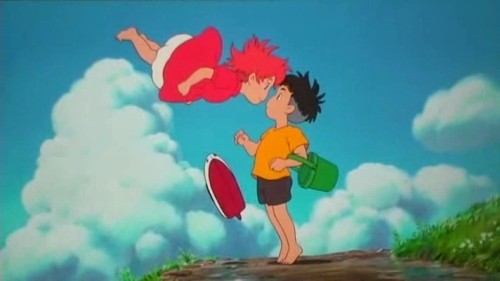
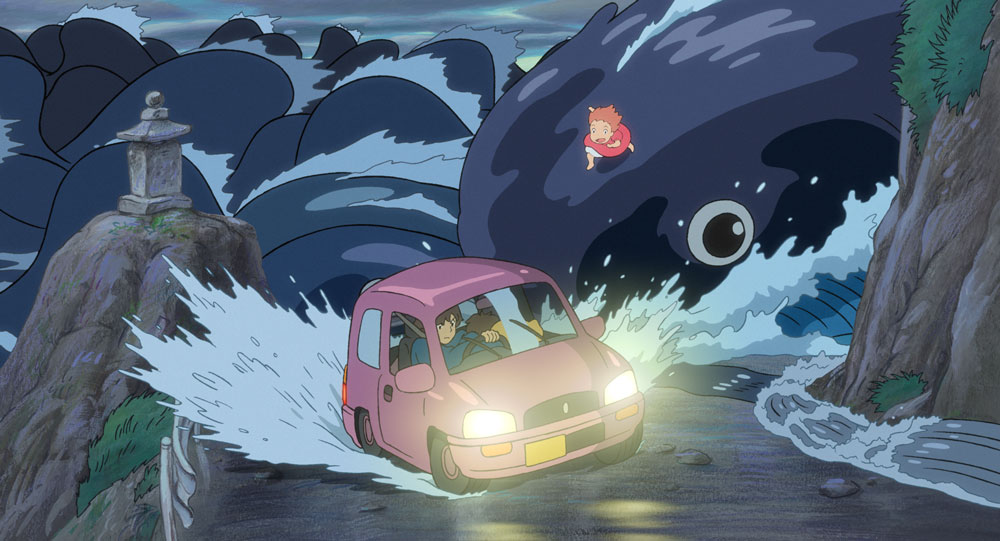
Ponyo (2008)
I was really delighted by Ponyo, Hayao Miyazaki’s latest fantastical children’s tale that springs from the most basic details of Hans Christian Andersen’s story “The Little Mermaid”.
Because I am a huge Miyazaki fan, it came as no surprise that I was entirely charmed by this movie. However, watching Ponyo helped me articulate to myself just what, exactly, I find enjoyable about Miyazaki’s films.
The aspects I enjoyed the most, in the case of Ponyo specifically, were the expressiveness of the animation and the near perfect conveyance of the wonderfully illogical imagination of children via the fantastical storyline and some of the film’s imagery.
In Ponyo the ocean is alive. It is filled with towering waves the size of monsters, fish-cronies that melt into the water, baby-faced mermaids that bulge into huge carp, goldfish that shape-shift into small magical girls, inexplicably giant women who save ships from disaster, and a myriad of other weird creatures and moments that just are. And the best part—I didn’t need an explanation for any of it. Something about Miyazaki’s style both enables and emboldens me to simply appreciate the incredible creativity that goes into the film and accept it for what it is.
When I watch Miyazaki movies I feel happy, boundless, and hopeful. I feel like I can tackle life’s greatest problems and challenges without any of the grown-up baggage that so often drags me down in real life (i.e. fears, anxieties, memories of failure, etc). I think this is because in Miyazaki’s worlds strange, awful, scary things are happening all the time all around, but the children that have to get through it do so without batting an eye.
If only we could all live somewhere in Miyazaki’s dream worlds!
Because I am a huge Miyazaki fan, it came as no surprise that I was entirely charmed by this movie. However, watching Ponyo helped me articulate to myself just what, exactly, I find enjoyable about Miyazaki’s films.
The aspects I enjoyed the most, in the case of Ponyo specifically, were the expressiveness of the animation and the near perfect conveyance of the wonderfully illogical imagination of children via the fantastical storyline and some of the film’s imagery.
In Ponyo the ocean is alive. It is filled with towering waves the size of monsters, fish-cronies that melt into the water, baby-faced mermaids that bulge into huge carp, goldfish that shape-shift into small magical girls, inexplicably giant women who save ships from disaster, and a myriad of other weird creatures and moments that just are. And the best part—I didn’t need an explanation for any of it. Something about Miyazaki’s style both enables and emboldens me to simply appreciate the incredible creativity that goes into the film and accept it for what it is.
When I watch Miyazaki movies I feel happy, boundless, and hopeful. I feel like I can tackle life’s greatest problems and challenges without any of the grown-up baggage that so often drags me down in real life (i.e. fears, anxieties, memories of failure, etc). I think this is because in Miyazaki’s worlds strange, awful, scary things are happening all the time all around, but the children that have to get through it do so without batting an eye.
If only we could all live somewhere in Miyazaki’s dream worlds!
01 April 2010
How to Train Your Dragon (2010)
Ok so… I hate Jay Baruchel’s voice, which was kind of a problem here, being as he voices the main character.
Also a problem: generally unappealing character design. Some of these dragons looked like flying poops. I’m not kidding.
Story was decently entertaining, some funny moments. No surprises in terms of plot or message.
Fun and impressive use of 3-D. Very very cute characterization of one dragon (Toothless), who resembled a cross between a black cat and a pokemon.
Overall: meh. Not entirely a waste of time, but ultimately, forgettable.
Also a problem: generally unappealing character design. Some of these dragons looked like flying poops. I’m not kidding.
Story was decently entertaining, some funny moments. No surprises in terms of plot or message.
Fun and impressive use of 3-D. Very very cute characterization of one dragon (Toothless), who resembled a cross between a black cat and a pokemon.
Overall: meh. Not entirely a waste of time, but ultimately, forgettable.
21 March 2010
Alice in Wonderland Commentary Followup
...Because it was so big it merited its own post.
@Chris
You say that you don’t like Tim Burton for two reasons. 1) “his dark and creepy imagery that is portrayed in nearly all of his films” and 2) “the constant praise by die hard conformist followers of "Tim Burton is hip and weird, thus awesome… so I'll believe he is hip and awesome too!" crowd.” But then later you say “knowing the bizarreness naturally associated with the Alice in Wonderland saga, I couldn't bring myself to hate this movie but at the same time, I wasn’t overly captivated or wowed by it.”
What I gather from your commentary is that you don’t like Tim Burton because of the bizarre imagery and dark themes he often uses and because he is, in your opinion, overrated by people who are simply following the crowd. But in this case you grudgingly accept Burton’s bizarre imagery in Alice because the pre-existing story world seems to require it.
So my question for you, Mr. Guy Who Loves Dark Twisted Movies Like The Tin Drum, is would you be willing to accept Burton’s work, and even maybe really enjoy it, if he wasn’t so popular? Or is it something in particular about Burton’s aesthetic/thematic creepiness that puts you off?
Just wondering!
@Alla
With regard to the moral of the story:
I didn’t say that there is no moral to the story in this decidedly different variation of a distinctly Disney movie. What I said was that I was relieved that Burton didn’t rely on elaborate yet obvious direct metaphors to carry his heroine through her fantasy world. In other words, what I was dreading was a sort of Wizard of Oz scenario in which each character presented to Alice in Wonderland has a direct counterpart in the real world—i.e. the Red Queen being directly relatable to some tyrannical figure in the real world, the Mad Hatter being analogous to a quirky acquaintance, etc. I was so happy to see that a lot of the characters in this version of Alice were actually just independently random (odd, endearing, frightening, horrifying) weirdos.
I also liked that the blue butterfly at the end (presumably the now metamorphosized Absolom the blue caterpillar) showed up in the “real” world, thereby further highlighting the tenuous boundaries between the fantasy space and that of “reality.” I think what really appealed to me was that Alice’s whole Wonderland/Underland adventure was consistently emphasized to be real—that there were fairly high stakes despite the whimsy of the place. It was emphatically not just a dream, and Alice was affected (physically by wounds, mentally by whatever growth she achieved during her stay) by this world.
This all set aside, I do realize that when the White Queen says the line about “when you face the Jabberwocky, you go alone” that this is a literal voicing of a message or moral Alice is supposed to be gaining from her adventures. I concede that the moral is obvious in this moment, and frankly, probably really necessarily so, because I think this movie was a bit crazy and probably difficult for children to process without such a handy take away statement of “the point”. I guess for me this obvious moment is forgivable, though, for a few reasons.
Firstly, that this message comes from The White Queen, who was a character that I thought felt pretty new and interesting. She was not your typical motherly figure, nor a romantic interest, nor even a particularly heroic figure herself. I don’t know where I’m going with this—something about her just really appealed to me. And secondly, and definitely more importantly, I loved that the moral itself was about independence and decision-making. It related to personal responsibility and consequences, risk taking and facing unknown outcomes. Even though the characters referred to the Oraculum throughout the film to see what “destiny” held for Alice, there was still a lot of room for deviation from this path. They kept checking the thing to see if it had changed. It felt less like a sword in the stone, destiny cannot be avoided type of thing than a “you may or may not live up to your potential depending on your choices” sort of thing.
About the Mad Hatter and Alice’s Relationship:
Woah. I totally did not read any kind of romantic relationship into their interaction with one another. I read only a weird and friendly vibe between them. Regardless as to what either one of us did or did not take from their onscreen interactions, the more important point, for me, is that there is no blatant love/romantic relationship in the film that determines Alice’s success or failure as a character. Even her relationship with her suitor in the “real” world is presented as a joke from the get-go. We are never led to believe Alice’s fate hinges on her getting a guy. I mean, obviously, we know that things would probably suck for her if she did marry the weak-chinned suitor, but it’s not like she’s going to seem like a failure if she doesn’t find a replacement.
About Imperialism:
Similarly to the questionable romance between the Hatter and Alice, I don’t think that any kind of endorsement of imperialistic values was really supposed to be the point of this movie. I’m not saying it wasn’t in there—it totally was. I mean… she was pretty much the heir to the British East India Company. “To be the first to trade with China! Imagine it!!”
But I think the whole Imperialism thing was just a product of Alice in Wonderland being written in 1865, not a plot by Tim Burton to indoctrinate young moviegoers into that particular mentality. So it didn't bother me at all.
Anyway… thanks for the provocative commentary. I think I wrote more and thought more about this comment than I’ve written on anything in … a really long time. And I didn't even think this movie was that awesome! I just liked it!
Hope you are enjoying your own adventures!
:)
@Chris
You say that you don’t like Tim Burton for two reasons. 1) “his dark and creepy imagery that is portrayed in nearly all of his films” and 2) “the constant praise by die hard conformist followers of "Tim Burton is hip and weird, thus awesome… so I'll believe he is hip and awesome too!" crowd.” But then later you say “knowing the bizarreness naturally associated with the Alice in Wonderland saga, I couldn't bring myself to hate this movie but at the same time, I wasn’t overly captivated or wowed by it.”
What I gather from your commentary is that you don’t like Tim Burton because of the bizarre imagery and dark themes he often uses and because he is, in your opinion, overrated by people who are simply following the crowd. But in this case you grudgingly accept Burton’s bizarre imagery in Alice because the pre-existing story world seems to require it.
So my question for you, Mr. Guy Who Loves Dark Twisted Movies Like The Tin Drum, is would you be willing to accept Burton’s work, and even maybe really enjoy it, if he wasn’t so popular? Or is it something in particular about Burton’s aesthetic/thematic creepiness that puts you off?
Just wondering!
@Alla
With regard to the moral of the story:
I didn’t say that there is no moral to the story in this decidedly different variation of a distinctly Disney movie. What I said was that I was relieved that Burton didn’t rely on elaborate yet obvious direct metaphors to carry his heroine through her fantasy world. In other words, what I was dreading was a sort of Wizard of Oz scenario in which each character presented to Alice in Wonderland has a direct counterpart in the real world—i.e. the Red Queen being directly relatable to some tyrannical figure in the real world, the Mad Hatter being analogous to a quirky acquaintance, etc. I was so happy to see that a lot of the characters in this version of Alice were actually just independently random (odd, endearing, frightening, horrifying) weirdos.
I also liked that the blue butterfly at the end (presumably the now metamorphosized Absolom the blue caterpillar) showed up in the “real” world, thereby further highlighting the tenuous boundaries between the fantasy space and that of “reality.” I think what really appealed to me was that Alice’s whole Wonderland/Underland adventure was consistently emphasized to be real—that there were fairly high stakes despite the whimsy of the place. It was emphatically not just a dream, and Alice was affected (physically by wounds, mentally by whatever growth she achieved during her stay) by this world.
This all set aside, I do realize that when the White Queen says the line about “when you face the Jabberwocky, you go alone” that this is a literal voicing of a message or moral Alice is supposed to be gaining from her adventures. I concede that the moral is obvious in this moment, and frankly, probably really necessarily so, because I think this movie was a bit crazy and probably difficult for children to process without such a handy take away statement of “the point”. I guess for me this obvious moment is forgivable, though, for a few reasons.
Firstly, that this message comes from The White Queen, who was a character that I thought felt pretty new and interesting. She was not your typical motherly figure, nor a romantic interest, nor even a particularly heroic figure herself. I don’t know where I’m going with this—something about her just really appealed to me. And secondly, and definitely more importantly, I loved that the moral itself was about independence and decision-making. It related to personal responsibility and consequences, risk taking and facing unknown outcomes. Even though the characters referred to the Oraculum throughout the film to see what “destiny” held for Alice, there was still a lot of room for deviation from this path. They kept checking the thing to see if it had changed. It felt less like a sword in the stone, destiny cannot be avoided type of thing than a “you may or may not live up to your potential depending on your choices” sort of thing.
About the Mad Hatter and Alice’s Relationship:
Woah. I totally did not read any kind of romantic relationship into their interaction with one another. I read only a weird and friendly vibe between them. Regardless as to what either one of us did or did not take from their onscreen interactions, the more important point, for me, is that there is no blatant love/romantic relationship in the film that determines Alice’s success or failure as a character. Even her relationship with her suitor in the “real” world is presented as a joke from the get-go. We are never led to believe Alice’s fate hinges on her getting a guy. I mean, obviously, we know that things would probably suck for her if she did marry the weak-chinned suitor, but it’s not like she’s going to seem like a failure if she doesn’t find a replacement.
About Imperialism:
Similarly to the questionable romance between the Hatter and Alice, I don’t think that any kind of endorsement of imperialistic values was really supposed to be the point of this movie. I’m not saying it wasn’t in there—it totally was. I mean… she was pretty much the heir to the British East India Company. “To be the first to trade with China! Imagine it!!”
But I think the whole Imperialism thing was just a product of Alice in Wonderland being written in 1865, not a plot by Tim Burton to indoctrinate young moviegoers into that particular mentality. So it didn't bother me at all.
Anyway… thanks for the provocative commentary. I think I wrote more and thought more about this comment than I’ve written on anything in … a really long time. And I didn't even think this movie was that awesome! I just liked it!
Hope you are enjoying your own adventures!
:)
15 March 2010
Alice in Wonderland (2010)
Liked:
- All the wonderful colors
- Female protagonist with no romantic imperative
- Subtle (inappropriately?) dark moments
- Outrageous grotesquerie
- The costumes, especially Alice's
- The March Hare
- The pleasant demeanor of the Cheshire Cat
- Johnny Depp's switching accents
- Anne Hathaway's gagging
Did not like:
- The use (perhaps the misuse of or the lack of use of) of 3D in the 3D version (I think 2D was better)
- The futterwhacking dance
- The lame music that went along with the futterwhacking dance
- The overall mellow vibe (would have preferred a bit more crazy of a pace for such a mad story world)
Overall I have to say I thoroughly enjoyed this most recent version of Alice in Wonderland. Much serendipity came from the details and not the overall story. From The Cheshire Cat "breading" when he lands on Hatter's hat in the prison cell to the subtle yet impossible stretching of the Knave's arms and legs, I found details throughout this film that made me happy to be paying attention.
Also, I was so so pleased that the fantasy of the story turned out to be traveling to a place where you can figure out the answers to your most crucial, puzzling life questions on your own, instead of a fantasy where morals are handed to you neatly by a prince in shining armor or are revealed by a convenient metaphor mirroring your own predicament.
Definitely worth watching.
- All the wonderful colors
- Female protagonist with no romantic imperative
- Subtle (inappropriately?) dark moments
- Outrageous grotesquerie
- The costumes, especially Alice's
- The March Hare
- The pleasant demeanor of the Cheshire Cat
- Johnny Depp's switching accents
- Anne Hathaway's gagging
Did not like:
- The use (perhaps the misuse of or the lack of use of) of 3D in the 3D version (I think 2D was better)
- The futterwhacking dance
- The lame music that went along with the futterwhacking dance
- The overall mellow vibe (would have preferred a bit more crazy of a pace for such a mad story world)
Overall I have to say I thoroughly enjoyed this most recent version of Alice in Wonderland. Much serendipity came from the details and not the overall story. From The Cheshire Cat "breading" when he lands on Hatter's hat in the prison cell to the subtle yet impossible stretching of the Knave's arms and legs, I found details throughout this film that made me happy to be paying attention.
Also, I was so so pleased that the fantasy of the story turned out to be traveling to a place where you can figure out the answers to your most crucial, puzzling life questions on your own, instead of a fantasy where morals are handed to you neatly by a prince in shining armor or are revealed by a convenient metaphor mirroring your own predicament.
Definitely worth watching.
21 January 2010
Youth in Revolt (2009)
Soooo. Filmmakers behind Youth in Revolt. Again with Michael Cera in the “young guy who really wants to not be a virgin anymore” role? Really?
…And the ill-advised audacity of shoehorning overly pretentious youths pining away for French Cinema of the ‘60s into this tired narrative?
…And using ridiculously poorly done “artsy” animations to pass the time between the hackneyed scenes of teenage romance?!
Please. Please do not do this kind of thing. Ever. Again.
P.S. Michael Cera: more Francois Dillinger roles, less Nick Twisp. Grow a pair, buddy. Take some freaking risks. You were almost sexy there for a second, guy. Almost.
…And the ill-advised audacity of shoehorning overly pretentious youths pining away for French Cinema of the ‘60s into this tired narrative?
…And using ridiculously poorly done “artsy” animations to pass the time between the hackneyed scenes of teenage romance?!
Please. Please do not do this kind of thing. Ever. Again.
P.S. Michael Cera: more Francois Dillinger roles, less Nick Twisp. Grow a pair, buddy. Take some freaking risks. You were almost sexy there for a second, guy. Almost.
22 December 2009
Avatar (2009)
Wow!!!!!!!!!!!!!
I could leave it at that, but I probably should elaborate at least a little, being as this is the last post before 2010.
First the obvious: beautiful visuals, seriously (no really—SERIOUSLY) astounding technology. You will forget that what you are watching isn’t real, which I think ought to be the goal of any movie, heavily CGI’ed or otherwise.
Second: plot. Kudos to you, James Cameron. You got me to genuinely enjoy an admittedly cliché story. Sure, I could turn to Fern Gulley: The Last Rainforest or even (as a friend pointed out) Dances with Wolves for a similar narrative experience, but given the choice I would pick Avatar because it was entirely engaging through and through. I forgot about the cheesiness and just enjoyed the adventure.
Finally: hello grown-up use of 3-D! Thanks for not having random objects fly out of the screen toward my face. Tasteful and thoughtful interaction with human beings’ sense of depth perception.
Don’t wait for DVD—you really need to see this in theaters. Even if you don’t like it or it spurs you to launch your own phantasmagoria of complaints, it is an experience that you really mustn’t pass up.
I could leave it at that, but I probably should elaborate at least a little, being as this is the last post before 2010.
First the obvious: beautiful visuals, seriously (no really—SERIOUSLY) astounding technology. You will forget that what you are watching isn’t real, which I think ought to be the goal of any movie, heavily CGI’ed or otherwise.
Second: plot. Kudos to you, James Cameron. You got me to genuinely enjoy an admittedly cliché story. Sure, I could turn to Fern Gulley: The Last Rainforest or even (as a friend pointed out) Dances with Wolves for a similar narrative experience, but given the choice I would pick Avatar because it was entirely engaging through and through. I forgot about the cheesiness and just enjoyed the adventure.
Finally: hello grown-up use of 3-D! Thanks for not having random objects fly out of the screen toward my face. Tasteful and thoughtful interaction with human beings’ sense of depth perception.
Don’t wait for DVD—you really need to see this in theaters. Even if you don’t like it or it spurs you to launch your own phantasmagoria of complaints, it is an experience that you really mustn’t pass up.
17 December 2009
Fantastic Mr. Fox (2009)
Like all other Wes Anderson movies, Fantastic Mr. Fox was entertaining, witty, and well thought out. The film had a decent streak of playfulness in its humor. And while Anderson catered more to adults than children, the movie nevertheless remained sufficiently childlike in its imagination to keep me interested and entertained. However, I found that I couldn’t love it like I loved his other movies, and surprisingly, I think it was because it was animated. Ironic, coming from someone who usually obsesses over all things animated!
I was sincerely awed by animation director Henry Selick’s work on Nightmare before Christmas and Coraline1. And according to Wikipedia, the same crew was employed for Corpse Bride was used for Fantastic Mr. Fox.2 So what happened here?
The source of my dislike was not located in the quality of the direction or the use of technology. The problem was two pronged; I did not like the overall aesthetic and I did not like the design of the characters themselves. The visual feel of Fantastic Mr. Fox is very similar to Anderson’s other movies, especially The Royal Tenenbaums.3 It’s sort of seventies, eclectic, and has lots of pinks, yellows, and browns. Unfortunately, whereas this aesthetic in Anderson's other films seemed unique and quirky, here it just made the whole thing look oddly cheap. Second, I didn’t like the design of the characters. The voice actors were highly expressive but the actual models they used for the foxes and other animals lacked life. They looked more like weird figurine toys than living characters. It is likely that this toy-like quality was intentional on Anderson’s part, but I just didn’t enjoy it very much.
Overall though these qualms with the animation were minor when compared to my overall enjoyment of the movie. Great dialogue, exciting story, and silly antics. In the end it was at least maybe a little bit fantastic indeed.
--
1. To mention only a few. See his imdb profile for details.
2. Sorry, I’m not a grad student anymore. I can’t really be bothered to do actual research. Plus I have no access to an academic library.
3. One of my all time favorite movies ever. EVER.
I was sincerely awed by animation director Henry Selick’s work on Nightmare before Christmas and Coraline1. And according to Wikipedia, the same crew was employed for Corpse Bride was used for Fantastic Mr. Fox.2 So what happened here?
The source of my dislike was not located in the quality of the direction or the use of technology. The problem was two pronged; I did not like the overall aesthetic and I did not like the design of the characters themselves. The visual feel of Fantastic Mr. Fox is very similar to Anderson’s other movies, especially The Royal Tenenbaums.3 It’s sort of seventies, eclectic, and has lots of pinks, yellows, and browns. Unfortunately, whereas this aesthetic in Anderson's other films seemed unique and quirky, here it just made the whole thing look oddly cheap. Second, I didn’t like the design of the characters. The voice actors were highly expressive but the actual models they used for the foxes and other animals lacked life. They looked more like weird figurine toys than living characters. It is likely that this toy-like quality was intentional on Anderson’s part, but I just didn’t enjoy it very much.
Overall though these qualms with the animation were minor when compared to my overall enjoyment of the movie. Great dialogue, exciting story, and silly antics. In the end it was at least maybe a little bit fantastic indeed.
--
1. To mention only a few. See his imdb profile for details.
2. Sorry, I’m not a grad student anymore. I can’t really be bothered to do actual research. Plus I have no access to an academic library.
3. One of my all time favorite movies ever. EVER.
06 December 2009
Whisper of the Heart (1995)
This movie… explained EVERYTHING. At least with regard to its sort of sequel The Cat Returns, the oddball adventure movie I reviewed a while back and valued for its sheer whimsy.
In Whisper of the Heart we see that the lead characters of The Cat Returns (The Baron and Muta) are very minor characters that figure in a narrative about finding out what you really want out of life. Whereas Cat takes some serious flights of fancy, Whisper is far more solidly located in the real world. In it we follow Shizuku through Tokyo as she struggles to decide what path she wants to take in life. She has to face obstacles stemming from family, love, and problems with self-worth while she pursues her goal of becoming a writer.
Though Whisper can’t compete with Cat for first prize in weird, Whisper does have hugely superior quality animation. And while Cat is a bit silly and hard to take seriously on the level of plot, Whisper is way more emotionally engaging. Definitely more along the lines of what you would expect from Studio Ghibli.
Overall, Whisper of the Heart is good for the same thing every other Ghibli film is good for—interesting visuals, interesting narrative, and all around great animated filmmaking!
In Whisper of the Heart we see that the lead characters of The Cat Returns (The Baron and Muta) are very minor characters that figure in a narrative about finding out what you really want out of life. Whereas Cat takes some serious flights of fancy, Whisper is far more solidly located in the real world. In it we follow Shizuku through Tokyo as she struggles to decide what path she wants to take in life. She has to face obstacles stemming from family, love, and problems with self-worth while she pursues her goal of becoming a writer.
Though Whisper can’t compete with Cat for first prize in weird, Whisper does have hugely superior quality animation. And while Cat is a bit silly and hard to take seriously on the level of plot, Whisper is way more emotionally engaging. Definitely more along the lines of what you would expect from Studio Ghibli.
Overall, Whisper of the Heart is good for the same thing every other Ghibli film is good for—interesting visuals, interesting narrative, and all around great animated filmmaking!
23 November 2009
A Christmas Carol (2009)
Let me begin by saying that I love Charles Dickens’s classic novella “A Christmas Carol.” I’ve seen countless film adaptations of the story and it never gets old.1 I even dressed up as the unfortunate and terrible ghost of Jacob Marley for Halloween one year during high school after carefully reading the original to make sure I got the details right.
So when Robert “I shat upon the classic picture book The Polar Express by adding Tom Hanks and weird dead-eyed animated children into the mix” Zemeckis took this project on, I cringed, and not a little bit.2 But I went to see anyway it because I still love Dickens’s story, by gum. And as long as they didn’t deviate from the original plot too much, it couldn’t be all bad.
Much to my relief, it wasn’t too horrible at all. Yeah, you do have to contend with the “Ooh look at me using 3-D” moments. One too many scenes with Scrooge falling and flailing through the air for my taste. And yeah, you do have to deal with the persistently dead-eyed characters. I don’t care whether they did use retinal scanning technology to try to get rid of the dead eyes—it didn’t entirely work and the effect is alienating.
But happily the movie does deliver some of the most important pleasures of Dickens's original text. While surprisingly leaving the old style prose intact, Zemeckis nevertheless makes the effort to bring something new to the party by playing up the ghostly characters to an extreme. Plus Jim Carrey does an unexpectedly great job at interpreting many different roles, all mercifully distant from his previous less than fresh work.
Overall, not the best adaptation of Dickens’s story so far, but one which certainly promises many more yet to come. And I can't say humbug to that!
-----
1. Shout out to my all time favorite, The Muppet Christmas Carol (1992)!!
2. Not an entirely fair assessment of Zemeckis, to be sure—he has produced, written, and directed a number of movies that I have enjoyed quite a bit. I just took The Polar Express personally because, as a child who was literally devastated by the revelation that Santa isn’t real, I clung desperately to the message of faith that was in the original text of The Polar Express. I still have the little jingle bell that came with the book.
So when Robert “I shat upon the classic picture book The Polar Express by adding Tom Hanks and weird dead-eyed animated children into the mix” Zemeckis took this project on, I cringed, and not a little bit.2 But I went to see anyway it because I still love Dickens’s story, by gum. And as long as they didn’t deviate from the original plot too much, it couldn’t be all bad.
Much to my relief, it wasn’t too horrible at all. Yeah, you do have to contend with the “Ooh look at me using 3-D” moments. One too many scenes with Scrooge falling and flailing through the air for my taste. And yeah, you do have to deal with the persistently dead-eyed characters. I don’t care whether they did use retinal scanning technology to try to get rid of the dead eyes—it didn’t entirely work and the effect is alienating.
But happily the movie does deliver some of the most important pleasures of Dickens's original text. While surprisingly leaving the old style prose intact, Zemeckis nevertheless makes the effort to bring something new to the party by playing up the ghostly characters to an extreme. Plus Jim Carrey does an unexpectedly great job at interpreting many different roles, all mercifully distant from his previous less than fresh work.
Overall, not the best adaptation of Dickens’s story so far, but one which certainly promises many more yet to come. And I can't say humbug to that!
-----
1. Shout out to my all time favorite, The Muppet Christmas Carol (1992)!!
2. Not an entirely fair assessment of Zemeckis, to be sure—he has produced, written, and directed a number of movies that I have enjoyed quite a bit. I just took The Polar Express personally because, as a child who was literally devastated by the revelation that Santa isn’t real, I clung desperately to the message of faith that was in the original text of The Polar Express. I still have the little jingle bell that came with the book.
22 November 2009
The Cat Returns (2002)
One day Haru, a down on her luck school girl with poor self confidence, uses her lacrosse stick to daringly rescue a cat from getting hit by a truck. Haru is informed that she has unwittingly saved the Prince of Cats which she thinks is a hallucination until suspiciously cat-friendly gifts start showing up everywhere she goes (e.g. hordes of mice, a field of cattails, stores of catnip). She decides to travel to the Kingdom of Cats to stop the well meaning but often embarrassing gifts, but once there Haru finds herself engaged against her will to the Prince of Cats! Serious weirdness ensues.
This movie’s strength is definitely its tremendous oddness. From Haru’s unpredictable interactions with feline royalty to the crazy chase scenes involving rivers of cat minions that pick up characters and carry them away, everything from the plot to the imagery of this studio Ghibli production seems to be inspired by extreme stretches of the imagination.
Unfortunately any potential for greatness this crazy weird adventure has is dashed to bits by the poor quality of the animation. Characters change size and scale constantly leading to confusion regarding basic spatial relationships. Haru’s face is unexpressive to a problematic degree—there is little difference in her appearance when she is happy, scared, or angry. Continuity errors abound, backgrounds look cheaply done, and there are some serious issues with the way the animators handle changes in lighting.
However, despite the shoddy quality of animation I still definitely recommend this movie for its sheer whimsy. At the end of the day The Cat Returns is a delightful flight of fancy that will make you laugh and feel lighthearted, even while scratching your head and exclaiming “What?!”
This movie’s strength is definitely its tremendous oddness. From Haru’s unpredictable interactions with feline royalty to the crazy chase scenes involving rivers of cat minions that pick up characters and carry them away, everything from the plot to the imagery of this studio Ghibli production seems to be inspired by extreme stretches of the imagination.
Unfortunately any potential for greatness this crazy weird adventure has is dashed to bits by the poor quality of the animation. Characters change size and scale constantly leading to confusion regarding basic spatial relationships. Haru’s face is unexpressive to a problematic degree—there is little difference in her appearance when she is happy, scared, or angry. Continuity errors abound, backgrounds look cheaply done, and there are some serious issues with the way the animators handle changes in lighting.
However, despite the shoddy quality of animation I still definitely recommend this movie for its sheer whimsy. At the end of the day The Cat Returns is a delightful flight of fancy that will make you laugh and feel lighthearted, even while scratching your head and exclaiming “What?!”
10 October 2009
Porco Rosso (1992)
In Porco Rosso we follow the story of an inexplicably pig-faced Italian World War I pilot turned bounty hunter who expertly out-flies pirates in his antique red plane. If that doesn’t sound bizarre or complicated enough for a Japanese children’s movie, consider that the pirates Porco Rosso (the Crimson Pig) fights turn out to be more civil than the Air Force who tries to intervene in their affairs. What’s more, at the end of the film we are left with few clear answers to any of the many questions regarding characters and plot that Miyazaki conjures up over the course of the story. We are expected to rely on our own imaginations to fill in the blanks, or not, as we see fit.
What I love best about Miyazaki movies, Porco Rosso included, is they not only display the beauty of a childlike uninhibited imagination visually, but that they also inspire imagination and thought that goes beyond the borders of the screen. Rather than spoon-feed the audience moral values through hackneyed plotlines and sugarcoated romances, Miyazaki instead offers breathtakingly strange and intriguing tales appropriate for any age. We go places when we watch his films. We see new things, we consider new possibilities. Just what animation, and film in general, is supposed to do.
With frequent magical and unexplained interventions into characters’ identities, highly unconventional narrative trajectories (at least in Western terms), and loads of astonishingly unexpected heroes, Miyazaki’s animated masterpieces are crafted for the truly adventurous and imaginative moviegoer. Lucky for us, in the treasure trove of Miyazaki’s work Porco Rosso is only one small gem.
----
If you’d like a bigger list of Miyazaki’s movies, check out his imdb profile.
(http://www.imdb.com/name/nm0594503/)
The majority of his movies are distributed in the US by Disney on very nice DVDs with options for either English language dubbing or English subtitles according to your preference.
What I love best about Miyazaki movies, Porco Rosso included, is they not only display the beauty of a childlike uninhibited imagination visually, but that they also inspire imagination and thought that goes beyond the borders of the screen. Rather than spoon-feed the audience moral values through hackneyed plotlines and sugarcoated romances, Miyazaki instead offers breathtakingly strange and intriguing tales appropriate for any age. We go places when we watch his films. We see new things, we consider new possibilities. Just what animation, and film in general, is supposed to do.
With frequent magical and unexplained interventions into characters’ identities, highly unconventional narrative trajectories (at least in Western terms), and loads of astonishingly unexpected heroes, Miyazaki’s animated masterpieces are crafted for the truly adventurous and imaginative moviegoer. Lucky for us, in the treasure trove of Miyazaki’s work Porco Rosso is only one small gem.
----
If you’d like a bigger list of Miyazaki’s movies, check out his imdb profile.
(http://www.imdb.com/name/nm0594503/)
The majority of his movies are distributed in the US by Disney on very nice DVDs with options for either English language dubbing or English subtitles according to your preference.
Subscribe to:
Posts (Atom)


 Posts
Posts