Iris (pronounced the French way, "ee-rees") isn't a movie; it's a Cirque du Soleil show that's playing right now at the Kodak Theater (where they film the Academy Awards) in L.A., the theme of which is the history of cinema and movie making.
Needless to say, when I several months ago first saw the advertisements for this show, I was overwhelmed with enthusiasm and excitement. This buoyant feeling almost immediately (and predictably) devolved into anxiety that Cirque would somehow manage to screw it up and thereby incur my wrath for sullying the subject that has been my passion for quite some time now. Despite my apprehension, however, I ended up deciding to go to the show anyway, because I've been fortunate enough to have seen several Cirque shows over the last ten years and I thoroughly enjoyed them all.
Fast forward to September 11th, 2011 (yes, I'm a little behind on my blogging) and you'll find me nearly moved to tears within seconds of being seated before the show starts, because I can see from the get-go that the crazy French Canadian Guy Laliberte (CEO of Cirque du Soleil) has done yet another mind bogglingly competent job putting together a crazy-weird-circus-fantasy spectacle.
My favorite pre-show attraction was the female mime wandering the crowd with a metal contraption surrounding her body. She solicited several people to spin her curious cylinder-skirt, and when no one would do it fast enough to suit her needs she gave it a yank herself. To the delight of the crowd, her skirt (which resembled a film reel turned on its side) revealed itself to be a working zoetrope showing boxers fighting each other in a short, repeated loop. Rewind to February of 2005 and you'll find a fresher-faced me sitting in my history of early cinema class at UC Berkeley watching a very enthusiastic young professor (Professor Kaveh Askari, a graduate of the University of Chicago (?) if you were wondering) demonstrating much smaller versions of the same pre-cinematic device and others like it. This was probably the moment that I decided I loved film and wanted to learn everything about it, and so for the Cirque show to reference it meant a lot to me. (<-- huge understatement)
The rest of the show was no different in terms of its emotional impact. Nearly every single aspect connected to some aspect of film as an art form, film history, or film production.
Some of the references made were:
- Norman McLaren's "Pas de deux"
- Georges Melies' "A Trip to the Moon"
- Edison's "Electrocution of an Elephant" (part of the Cinema of Attractions)
"The Kiss"
- Lotte Reiniger's "Adventures of Prince Achmed"
- Dziga Vertov's "The Man with the Movie Camera" or "The Cinematic Orchestra"
- The Al Jolson film "The Jazz Singer"
- And even what I took as a reference to a particular character from a Hayao Miyazaki film (Howl's Moving Castle)
All these references (and many, many more) were integrated with the usual Cirque spectacle of acrobatics, contortionists, a loose, somewhat dubious romantic narrative that ties the show together, wonderful live music, and some silly clowns which Cirque here opted to use to refer to modern day Hollywood industry stereotypes.
My favorite part was the McLaren reference, because it took a series of dancers and placed them in front of an enormous screen that showed their motion trails, just like in "Pas de deux". I also greatly relished the carnival/vaudeville aspect to this particular Cirque show (though I recognize it's a somewhat common theme throughout them and circus in general), because it connected back to the roots of film as a sort of freak show attraction. I also was just as much impressed by the integration of technology into the acts (I'm thinking in particular of one scene that's incredibly difficult to describe, so I'll leave it up to you to go experience it for yourself) as I was by the skill of the performers, some of whom are Olympic athletes.
I can't say whether many people in the audience understood these myriad references to cinema, but whether or not they did is not important to me. I loved the show because it reminded me of a time in my life not so long ago when I was ruled by a singular passion and drive inspired by the art form of film. Though this time isn't very far distant from me, it feels miles away. Because I am acutely aware of the literal (and metaphorical) distance I've traveled since those glorious days of oblivious (arguably naive) infatuation with my chosen subject of study, Iris moved me quite deeply insofar as it helped me reconnect with past moments in the sun, and I know this intensely personal experience would certainly not be what most people experience on seeing the show.
I highly recommend that you see Iris if you love film and you're in Los Angeles. You won't regret it.
Showing posts with label Foreign Language. Show all posts
Showing posts with label Foreign Language. Show all posts
13 October 2011


02 August 2011
The Illusionist (L'illusionniste) (2010)
The Illusionist is the animated interpretation of a script by the late great French filmmaker Jacques Tati. Directed by Sylvain Chomet (who was responsible for the much lauded The Triplets of Belleville (2003)), this film has a reputation for being compulsory viewing and is generally marketed as some type of Francophone animated masterpiece.
Admittedly, this aura of greatness is the justified result of being associated with both Tati and Chomet, whose honestly earned reputations managed to launch The Illusionist into that cringe-worthy category of film that "anyone interested in the cinema simply must see" and, implicitly, value and enjoy.
As you might expect, I could not wholeheartedly buy into the charm of this adaptation of Tati's work. Yes, the animation was charming. Yes, there were neat visual puns and clever tongue-in-cheek caricatures of various figures. Yes, there was a vicious rabbit and a wide eyed girl speaking Scottish Gaelic.
Yet there was a hole here, a gap. A lack. Charisma without depth, perhaps? The animation was nice, but not that creative. The story was gently frustrating, with safely low stakes for everyone involved. The extremely minimalistic dialogue was refreshing, but with so little a compelling story behind it, ultimately ill used.
Overall I sadly cannot recommend this film. If you're very interested in animation you'll probably watch it anyway, but consider yourself forewarned of disappointment.
Admittedly, this aura of greatness is the justified result of being associated with both Tati and Chomet, whose honestly earned reputations managed to launch The Illusionist into that cringe-worthy category of film that "anyone interested in the cinema simply must see" and, implicitly, value and enjoy.
As you might expect, I could not wholeheartedly buy into the charm of this adaptation of Tati's work. Yes, the animation was charming. Yes, there were neat visual puns and clever tongue-in-cheek caricatures of various figures. Yes, there was a vicious rabbit and a wide eyed girl speaking Scottish Gaelic.
Yet there was a hole here, a gap. A lack. Charisma without depth, perhaps? The animation was nice, but not that creative. The story was gently frustrating, with safely low stakes for everyone involved. The extremely minimalistic dialogue was refreshing, but with so little a compelling story behind it, ultimately ill used.
Overall I sadly cannot recommend this film. If you're very interested in animation you'll probably watch it anyway, but consider yourself forewarned of disappointment.
18 October 2010
Severed Ways (2007)
Wanna watch the worst movie ever? Watch this!
You’ll see:
-Poop coming out of a dude’s butt
-Extremely anachronistic headbanging to metal
-Guys in really bad wigs speaking slangy Norse in digitally-altered-to-be-lower voices
-Random acts of arson
-Unexplained and unnecessary shaky camera
-Beautiful scenery of northeastern Canada
In short: all you could ever wish for in a bad movie. Ripe for a couple hours of colorful commentary from you and your friends (possibly inebriated). Vent your pent up aggression, sarcasm, and rage toward your TV or computer screen. The movie can’t talk back, and won’t make any effort to get you to like it!
A spectacle of unspeakably bad moviemaking. Enjoy.
You’ll see:
-Poop coming out of a dude’s butt
-Extremely anachronistic headbanging to metal
-Guys in really bad wigs speaking slangy Norse in digitally-altered-to-be-lower voices
-Random acts of arson
-Unexplained and unnecessary shaky camera
-Beautiful scenery of northeastern Canada
In short: all you could ever wish for in a bad movie. Ripe for a couple hours of colorful commentary from you and your friends (possibly inebriated). Vent your pent up aggression, sarcasm, and rage toward your TV or computer screen. The movie can’t talk back, and won’t make any effort to get you to like it!
A spectacle of unspeakably bad moviemaking. Enjoy.
15 August 2010
The Girl Who Played with Fire (2009)
Pretty good overall. Noomi Rapace was awesome, again. And in the first few seconds of the movie it became clear that I’d misjudged the ending of the last one by a lot. All kinds of kick-ass going on in this movie, and no watered down B.S. romantic imperatives. What a relief.
The Girl Who Played with Fire, just like The Girl with the Dragon Tattoo, will make you consider what it means to watch brutal violence, specifically against women, on the big screen. Not necessarily a bad thing, but definitely difficult to watch at times. Worth the effort for the story and the compelling lead character.
Go see this (and rent the first one too) if you can, before Hollywood churns out its sure to be disappointing adaptation.
The Girl Who Played with Fire, just like The Girl with the Dragon Tattoo, will make you consider what it means to watch brutal violence, specifically against women, on the big screen. Not necessarily a bad thing, but definitely difficult to watch at times. Worth the effort for the story and the compelling lead character.
Go see this (and rent the first one too) if you can, before Hollywood churns out its sure to be disappointing adaptation.
27 April 2010
The Girl with the Dragon Tattoo (2009)
Oh, Girl with the Dragon Tattoo. You make it so difficult for me to confidently label this post as either favorable or unfavorable.
I loved the lead character named Lisbeth, played by Noomi Rapace. She is a very muscular, highly androgynous, tattooed and pierced young woman who in the first thirty minutes or so of the movie acts out what is (I think) a common retaliatory fantasy against rapists. On top of that, she’s a professional hacker who is fiercely independent, unsentimental, and unemotional, and yet somehow she remains easy to cheer for. And kudos to the filmmakers for making her bisexuality not be a sensationalistic point of interest in the story. It’s just a fact, uncommented upon, plain as day.
I also thoroughly enjoyed the plot, up to a point. With lots of sinister affiliations rolled into one, the whodunit story that brings Lisbeth and a publicly disgraced (but framed) journalist named Mikael Blomkvist together intrigues and entices. Full of brutal details that are kept disturbingly subtle on screen, the 40 year old murder lurches wrenchingly back to life, zombie-like in its horror and its fascination which grips the audience and the characters on screen alike. Extra unsettling moment: when Blomkvist places several old photographs of a missing woman taken in succession together to create a sort of flip-book effect, revealing an important detail about the day she disappeared.
The problem was that while I was wildly enthusiastic about certain aspects of the movie, I became really spitefully resentful toward others. Unfortunately, story-wise, the first two hours were good but the last half hour was just plain dumb. The Girl with the Dragon Tattoo started as a great mystery/thriller, i.e. a well paced, interesting (though not necessarily believable) story with very unique characters one could engage with, but then in the last half hour tragically devolved into a frustratingly neatly wrapped up cliché about familial ties and the virtues of heterosexual monogamy. Even the visual aesthetic switched from the cool (though expected) bluish grayish noir with a punk androgyne kicking ass in the beginning to an obnoxiously sunny-happy aesthetic, complete with tearful reunions, stilted confessions of emotional connections, and our (in my view) now fallen heroine sporting a large blonde wig, a business suit, and heels. What the hell.
I can’t even really decide whether the first two hours of the movie make it worth it to watch, either, because I just can’t ignore the flaws of the ending. What I wish is that I could re-watch the movie and just stop it around the point where things start to get ridiculous and add my own alternate ending mentally or something.
Anyway… the only way you’ll find out whether or not it’s worth it is to watch it yourself, which I suppose I can grudgingly recommend, if only for the majority of the movie and not the whole.
I loved the lead character named Lisbeth, played by Noomi Rapace. She is a very muscular, highly androgynous, tattooed and pierced young woman who in the first thirty minutes or so of the movie acts out what is (I think) a common retaliatory fantasy against rapists. On top of that, she’s a professional hacker who is fiercely independent, unsentimental, and unemotional, and yet somehow she remains easy to cheer for. And kudos to the filmmakers for making her bisexuality not be a sensationalistic point of interest in the story. It’s just a fact, uncommented upon, plain as day.
I also thoroughly enjoyed the plot, up to a point. With lots of sinister affiliations rolled into one, the whodunit story that brings Lisbeth and a publicly disgraced (but framed) journalist named Mikael Blomkvist together intrigues and entices. Full of brutal details that are kept disturbingly subtle on screen, the 40 year old murder lurches wrenchingly back to life, zombie-like in its horror and its fascination which grips the audience and the characters on screen alike. Extra unsettling moment: when Blomkvist places several old photographs of a missing woman taken in succession together to create a sort of flip-book effect, revealing an important detail about the day she disappeared.
The problem was that while I was wildly enthusiastic about certain aspects of the movie, I became really spitefully resentful toward others. Unfortunately, story-wise, the first two hours were good but the last half hour was just plain dumb. The Girl with the Dragon Tattoo started as a great mystery/thriller, i.e. a well paced, interesting (though not necessarily believable) story with very unique characters one could engage with, but then in the last half hour tragically devolved into a frustratingly neatly wrapped up cliché about familial ties and the virtues of heterosexual monogamy. Even the visual aesthetic switched from the cool (though expected) bluish grayish noir with a punk androgyne kicking ass in the beginning to an obnoxiously sunny-happy aesthetic, complete with tearful reunions, stilted confessions of emotional connections, and our (in my view) now fallen heroine sporting a large blonde wig, a business suit, and heels. What the hell.
I can’t even really decide whether the first two hours of the movie make it worth it to watch, either, because I just can’t ignore the flaws of the ending. What I wish is that I could re-watch the movie and just stop it around the point where things start to get ridiculous and add my own alternate ending mentally or something.
Anyway… the only way you’ll find out whether or not it’s worth it is to watch it yourself, which I suppose I can grudgingly recommend, if only for the majority of the movie and not the whole.
19 April 2010
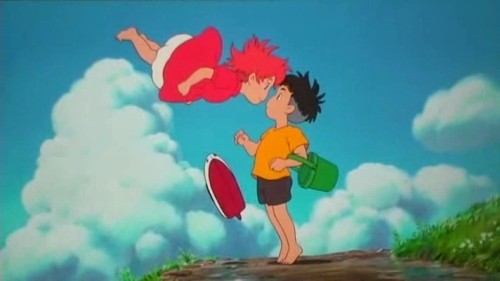
Ponyo (2008)
I was really delighted by Ponyo, Hayao Miyazaki’s latest fantastical children’s tale that springs from the most basic details of Hans Christian Andersen’s story “The Little Mermaid”.
Because I am a huge Miyazaki fan, it came as no surprise that I was entirely charmed by this movie. However, watching Ponyo helped me articulate to myself just what, exactly, I find enjoyable about Miyazaki’s films.
The aspects I enjoyed the most, in the case of Ponyo specifically, were the expressiveness of the animation and the near perfect conveyance of the wonderfully illogical imagination of children via the fantastical storyline and some of the film’s imagery.
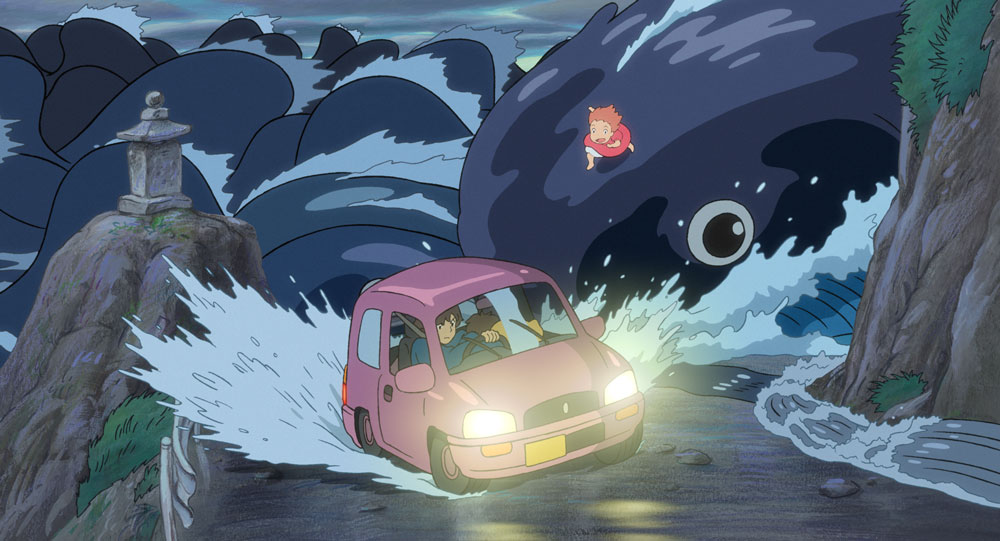
In Ponyo the ocean is alive. It is filled with towering waves the size of monsters, fish-cronies that melt into the water, baby-faced mermaids that bulge into huge carp, goldfish that shape-shift into small magical girls, inexplicably giant women who save ships from disaster, and a myriad of other weird creatures and moments that just are. And the best part—I didn’t need an explanation for any of it. Something about Miyazaki’s style both enables and emboldens me to simply appreciate the incredible creativity that goes into the film and accept it for what it is.
When I watch Miyazaki movies I feel happy, boundless, and hopeful. I feel like I can tackle life’s greatest problems and challenges without any of the grown-up baggage that so often drags me down in real life (i.e. fears, anxieties, memories of failure, etc). I think this is because in Miyazaki’s worlds strange, awful, scary things are happening all the time all around, but the children that have to get through it do so without batting an eye.
If only we could all live somewhere in Miyazaki’s dream worlds!
Because I am a huge Miyazaki fan, it came as no surprise that I was entirely charmed by this movie. However, watching Ponyo helped me articulate to myself just what, exactly, I find enjoyable about Miyazaki’s films.
The aspects I enjoyed the most, in the case of Ponyo specifically, were the expressiveness of the animation and the near perfect conveyance of the wonderfully illogical imagination of children via the fantastical storyline and some of the film’s imagery.
In Ponyo the ocean is alive. It is filled with towering waves the size of monsters, fish-cronies that melt into the water, baby-faced mermaids that bulge into huge carp, goldfish that shape-shift into small magical girls, inexplicably giant women who save ships from disaster, and a myriad of other weird creatures and moments that just are. And the best part—I didn’t need an explanation for any of it. Something about Miyazaki’s style both enables and emboldens me to simply appreciate the incredible creativity that goes into the film and accept it for what it is.
When I watch Miyazaki movies I feel happy, boundless, and hopeful. I feel like I can tackle life’s greatest problems and challenges without any of the grown-up baggage that so often drags me down in real life (i.e. fears, anxieties, memories of failure, etc). I think this is because in Miyazaki’s worlds strange, awful, scary things are happening all the time all around, but the children that have to get through it do so without batting an eye.
If only we could all live somewhere in Miyazaki’s dream worlds!
28 January 2010
La mujer sin cabeza [The Headless Woman] (2008)
In La mujer sin cabeza we watch as a middle class woman named Vero struggles to regain her sense of identity after she hits something with her car on a rural Argentinean road one afternoon. She does not know what she ran over on her way home from a get together—it could have been a dog or a person. She simply drives away after the accident, thereby inducing an odd dreamlike mental state that lasts for days on end following the incident.
I have been waiting with great anticipatory mania for the arrival of this movie, the most recent title by one of my favorite directors of all time, Lucrecia Martel. (She directed one of my favorite films, La ciénaga (2001), which I reviewed as part of my Top Ten off the Top of my Head list a while back.) And I have to say that while I’m not counting on La mujer sin cabeza to replace La ciénaga as one of my all time favorites just yet1, I still feel that it is an incredibly intriguing work because it contains the elements of Martel’s previous works that originally piqued my interest.
Like Martel’s other films, the point of La mujer sin cabeza is not actually the central event driving the rest of the story, but rather the odd, partially obscured details of the protagonist’s life that the ramifications of the central event draw out. As we follow the post-accident Vero wandering through her life in a somnambulistic haze, we catch a glimpse of the many strange and complex relationships surrounding her. We are privy to the unspoken details and whispers of Vero and her husband’s marriage, Vero’s relationship with her lover, Vero and her bedridden, addled mother, and the flirtation between Vero and her niece. Even with the peripheral characters of the film there are references to other ambiguous yet nuanced relationships that Martel hints at but never fully defines.
Indeed, what’s especially good about La mujer sin cabeza is that Martel refuses to offer explanations for many events and conversations, instead referencing the off-screen, the unsaid, the absent. However, rather than creating a void or a lack of meaning with all these question marks, Martel uses double entendre, ambient music, and overheard, half intelligible conversations to prove the existence of that which lies beyond her frame.
In the end Martel is able to say more by saying less, forcing us to focus in on the edges of her story-world, craning our necks to see if we can catch a glimpse of what lies just beyond the borders of the frame. This, for me, is great cinema.
--
1. You always have to watch Martel’s work several times over before you can begin to play favorites with characters and stories.
I have been waiting with great anticipatory mania for the arrival of this movie, the most recent title by one of my favorite directors of all time, Lucrecia Martel. (She directed one of my favorite films, La ciénaga (2001), which I reviewed as part of my Top Ten off the Top of my Head list a while back.) And I have to say that while I’m not counting on La mujer sin cabeza to replace La ciénaga as one of my all time favorites just yet1, I still feel that it is an incredibly intriguing work because it contains the elements of Martel’s previous works that originally piqued my interest.
Like Martel’s other films, the point of La mujer sin cabeza is not actually the central event driving the rest of the story, but rather the odd, partially obscured details of the protagonist’s life that the ramifications of the central event draw out. As we follow the post-accident Vero wandering through her life in a somnambulistic haze, we catch a glimpse of the many strange and complex relationships surrounding her. We are privy to the unspoken details and whispers of Vero and her husband’s marriage, Vero’s relationship with her lover, Vero and her bedridden, addled mother, and the flirtation between Vero and her niece. Even with the peripheral characters of the film there are references to other ambiguous yet nuanced relationships that Martel hints at but never fully defines.
Indeed, what’s especially good about La mujer sin cabeza is that Martel refuses to offer explanations for many events and conversations, instead referencing the off-screen, the unsaid, the absent. However, rather than creating a void or a lack of meaning with all these question marks, Martel uses double entendre, ambient music, and overheard, half intelligible conversations to prove the existence of that which lies beyond her frame.
In the end Martel is able to say more by saying less, forcing us to focus in on the edges of her story-world, craning our necks to see if we can catch a glimpse of what lies just beyond the borders of the frame. This, for me, is great cinema.
--
1. You always have to watch Martel’s work several times over before you can begin to play favorites with characters and stories.
10 January 2010
The Tin Drum (Die Blechtrommel) (1979)
So here’s something unusual: it seems I have writer’s block. That is why there has been a bit of a lag in my usual regular posting. Every time I sit down to write I end up averting my eyes from Word and lamely clicking around on the internet. To be fair, there has been some hugely amusing stuff out there lately, but nothing so interesting as to justify me becoming unable to casually barf out some snark about film and post it without actually editing, as I usually do.
Maybe this aversion to writing is a result of the movie I have been trying to write about, which was so odd I’m not even sure there’s any point in trying to describe it. I watched The Tin Drum, as far as I can gather is pretty much an essay in uncomfortable situations. The story is about a three year old boy in WWI-WWII era Germany who decides not to grow up. However, not growing up doesn’t stop him from having sex with people, being hell bent on destroying various precious objects, and being generally depraved no matter what the situation.
I actually really admired The Tin Drum for its sheer audacity in presenting these explicit situations of violence, abjection, and sexuality candidly. I also was extremely impressed by Angela Winkler’s performance as the mother of the weird-o perpetual toddler. I think the scenes when she goes blank and shoves preserved fish in her mouth are brilliant.
The main issue that I take with the film is that I couldn’t really figure out what the whole thing was supposed to mean. A lot of the time when you have an unusual or fantasy-ish storyline and it’s historically located in a really specific iconic period it means that the storytellers behind it are trying to construct some sort of metaphor that relates to an overarching moral or theme. For the life of me I could not figure out what the hell this bizarro tale was supposed to be saying.
Despite my own intellectual failings I still enjoyed the movie overall. A definite recommendation for anyone who likes to indulge in the darker side of cinema, with the added bonus of getting to watch the forest fairy named Gump from Legend (1985) get busy with his sixteen year old nanny.
Up Next:
Up in the Air
Maybe this aversion to writing is a result of the movie I have been trying to write about, which was so odd I’m not even sure there’s any point in trying to describe it. I watched The Tin Drum, as far as I can gather is pretty much an essay in uncomfortable situations. The story is about a three year old boy in WWI-WWII era Germany who decides not to grow up. However, not growing up doesn’t stop him from having sex with people, being hell bent on destroying various precious objects, and being generally depraved no matter what the situation.
I actually really admired The Tin Drum for its sheer audacity in presenting these explicit situations of violence, abjection, and sexuality candidly. I also was extremely impressed by Angela Winkler’s performance as the mother of the weird-o perpetual toddler. I think the scenes when she goes blank and shoves preserved fish in her mouth are brilliant.
The main issue that I take with the film is that I couldn’t really figure out what the whole thing was supposed to mean. A lot of the time when you have an unusual or fantasy-ish storyline and it’s historically located in a really specific iconic period it means that the storytellers behind it are trying to construct some sort of metaphor that relates to an overarching moral or theme. For the life of me I could not figure out what the hell this bizarro tale was supposed to be saying.
Despite my own intellectual failings I still enjoyed the movie overall. A definite recommendation for anyone who likes to indulge in the darker side of cinema, with the added bonus of getting to watch the forest fairy named Gump from Legend (1985) get busy with his sixteen year old nanny.
Up Next:
Up in the Air
06 December 2009
Whisper of the Heart (1995)
This movie… explained EVERYTHING. At least with regard to its sort of sequel The Cat Returns, the oddball adventure movie I reviewed a while back and valued for its sheer whimsy.
In Whisper of the Heart we see that the lead characters of The Cat Returns (The Baron and Muta) are very minor characters that figure in a narrative about finding out what you really want out of life. Whereas Cat takes some serious flights of fancy, Whisper is far more solidly located in the real world. In it we follow Shizuku through Tokyo as she struggles to decide what path she wants to take in life. She has to face obstacles stemming from family, love, and problems with self-worth while she pursues her goal of becoming a writer.
Though Whisper can’t compete with Cat for first prize in weird, Whisper does have hugely superior quality animation. And while Cat is a bit silly and hard to take seriously on the level of plot, Whisper is way more emotionally engaging. Definitely more along the lines of what you would expect from Studio Ghibli.
Overall, Whisper of the Heart is good for the same thing every other Ghibli film is good for—interesting visuals, interesting narrative, and all around great animated filmmaking!
In Whisper of the Heart we see that the lead characters of The Cat Returns (The Baron and Muta) are very minor characters that figure in a narrative about finding out what you really want out of life. Whereas Cat takes some serious flights of fancy, Whisper is far more solidly located in the real world. In it we follow Shizuku through Tokyo as she struggles to decide what path she wants to take in life. She has to face obstacles stemming from family, love, and problems with self-worth while she pursues her goal of becoming a writer.
Though Whisper can’t compete with Cat for first prize in weird, Whisper does have hugely superior quality animation. And while Cat is a bit silly and hard to take seriously on the level of plot, Whisper is way more emotionally engaging. Definitely more along the lines of what you would expect from Studio Ghibli.
Overall, Whisper of the Heart is good for the same thing every other Ghibli film is good for—interesting visuals, interesting narrative, and all around great animated filmmaking!
22 November 2009
The Cat Returns (2002)
One day Haru, a down on her luck school girl with poor self confidence, uses her lacrosse stick to daringly rescue a cat from getting hit by a truck. Haru is informed that she has unwittingly saved the Prince of Cats which she thinks is a hallucination until suspiciously cat-friendly gifts start showing up everywhere she goes (e.g. hordes of mice, a field of cattails, stores of catnip). She decides to travel to the Kingdom of Cats to stop the well meaning but often embarrassing gifts, but once there Haru finds herself engaged against her will to the Prince of Cats! Serious weirdness ensues.
This movie’s strength is definitely its tremendous oddness. From Haru’s unpredictable interactions with feline royalty to the crazy chase scenes involving rivers of cat minions that pick up characters and carry them away, everything from the plot to the imagery of this studio Ghibli production seems to be inspired by extreme stretches of the imagination.
Unfortunately any potential for greatness this crazy weird adventure has is dashed to bits by the poor quality of the animation. Characters change size and scale constantly leading to confusion regarding basic spatial relationships. Haru’s face is unexpressive to a problematic degree—there is little difference in her appearance when she is happy, scared, or angry. Continuity errors abound, backgrounds look cheaply done, and there are some serious issues with the way the animators handle changes in lighting.
However, despite the shoddy quality of animation I still definitely recommend this movie for its sheer whimsy. At the end of the day The Cat Returns is a delightful flight of fancy that will make you laugh and feel lighthearted, even while scratching your head and exclaiming “What?!”
This movie’s strength is definitely its tremendous oddness. From Haru’s unpredictable interactions with feline royalty to the crazy chase scenes involving rivers of cat minions that pick up characters and carry them away, everything from the plot to the imagery of this studio Ghibli production seems to be inspired by extreme stretches of the imagination.
Unfortunately any potential for greatness this crazy weird adventure has is dashed to bits by the poor quality of the animation. Characters change size and scale constantly leading to confusion regarding basic spatial relationships. Haru’s face is unexpressive to a problematic degree—there is little difference in her appearance when she is happy, scared, or angry. Continuity errors abound, backgrounds look cheaply done, and there are some serious issues with the way the animators handle changes in lighting.
However, despite the shoddy quality of animation I still definitely recommend this movie for its sheer whimsy. At the end of the day The Cat Returns is a delightful flight of fancy that will make you laugh and feel lighthearted, even while scratching your head and exclaiming “What?!”
20 November 2009
Coco before Chanel (2009)
This quiet biopic about Gabrielle “Coco” Chanel before she got famous is pleasant enough to watch but ultimately forgettable once you walk out of the theater.
It’s not that the acting or the plot is lackluster. On the contrary, it is quite engaging to see how Chanel goes from rags to riches by sheer force of will. Audrey Tautou artfully shows us just what kind of character is needed in order for Chanel to succeed, especially in light of the considerable obstacles with which an orphaned woman in turn of the century France was faced.
I think for me the problem was that the film did have some emotional content, showing Chanel in complicated romantic situations with a variety of men, but that somehow at the end of the day we could still only look on Chanel’s story from the outside. It was as though we had been invited to look through a window at her life, but never quite got invited inside to join in.
Perhaps this keeping the audience at arm’s length was the point; Chanel is repeatedly characterized as independent to the degree of aloofness throughout the film. However, this coldness had the effect of creating a certain degree of indifference in me toward Chanel—at the end of the film I didn’t really feel anything at all.
It’s not that the acting or the plot is lackluster. On the contrary, it is quite engaging to see how Chanel goes from rags to riches by sheer force of will. Audrey Tautou artfully shows us just what kind of character is needed in order for Chanel to succeed, especially in light of the considerable obstacles with which an orphaned woman in turn of the century France was faced.
I think for me the problem was that the film did have some emotional content, showing Chanel in complicated romantic situations with a variety of men, but that somehow at the end of the day we could still only look on Chanel’s story from the outside. It was as though we had been invited to look through a window at her life, but never quite got invited inside to join in.
Perhaps this keeping the audience at arm’s length was the point; Chanel is repeatedly characterized as independent to the degree of aloofness throughout the film. However, this coldness had the effect of creating a certain degree of indifference in me toward Chanel—at the end of the film I didn’t really feel anything at all.
14 November 2009
Paris, je t'aime (2006)
The conceptual predecessor to New York, I Love You, Paris, je t’aime is about relationships and love in the city of Paris. Each vignette of this film is named for the neighborhood in which it takes place. Transitions between each story are abrupt, marked only by a cut and an unobtrusive title appearing in one corner of the frame, which tells you which neighborhood you’re now in. There is ample quiet time at the beginning and end of each short to allow you to reflect on what you’ve seen.
Storylines run the gamut between a mother dealing with the loss of her child to mimes making eyes at each other in a jail cell. All different kinds of love, all different kinds of relationships, and all different kinds of people. Hopefully something for everyone.
I liked Paris, je t’aime more than New York, I Love You. I don’t know if it was the French language, the city it was set in, or just the construction of the film itself. But something about the former made the latter look a little like a cheap imitation in my eyes. Not so much that it was completely invalidated, but just enough to make me really appreciate the original.
You’ll have to see for yourself. Definitely worth watching.
Storylines run the gamut between a mother dealing with the loss of her child to mimes making eyes at each other in a jail cell. All different kinds of love, all different kinds of relationships, and all different kinds of people. Hopefully something for everyone.
I liked Paris, je t’aime more than New York, I Love You. I don’t know if it was the French language, the city it was set in, or just the construction of the film itself. But something about the former made the latter look a little like a cheap imitation in my eyes. Not so much that it was completely invalidated, but just enough to make me really appreciate the original.
You’ll have to see for yourself. Definitely worth watching.
11 November 2009
The Beaches of Agnes (Les plages d'Agnes) (2008)
This film is a remarkable reflection by filmmaker Agnes Varda on her life, both personal and professional.
The Beaches of Agnes is visually complex to an impressive degree—Varda layers images from previous films over reenactments of events from her childhood, relayed through mirrors and frames, filtered through even more layers of images, sometimes with commentary from a cartoon cat said to represent the voice of a famous filmmaker of the French New Wave, of which Varda was a part. A mixture of whimsical and tragic, strange and yet strikingly familiar, none of the imagery or commentary can be said to operate around a central theme. Except perhaps the tricky tendencies of memory.
Events and images overlap, temporality is unclear, symbols and metaphors recur but their meanings shift and change. Varda herself provides fewer answers than questions; she makes no pretense of guiding the viewer on a tour of her career or her life, but rather works through her musings on life on her own time. What she shares with us is not a neat autobiography, but rather a collage of the thoughts that might cross through her mind when she thinks back on where she’s been.
What this all amounts to is a movie that requires thought, through and through. Should you choose to spend your time contemplating Varda’s, you may come away feeling lost, puzzled, or perplexed.
This film also, on some level, requires knowledge of Varda’s work—a oeuvre of which a sadly small number of people have knowledge. If you are interested in checking out her movies, which I highly suggest, skim her imdb profile for releases that interest you. Her Cleo from 5 to 7 made it onto my top ten list a while back, but she has many other gems to offer. Some are available on Netflix, and more are coming soon thanks to the Criterion Collection’s recent-ish release of a box set of her films.
Even if you haven’t seen her movies, I think you should still check this one out at your local art house theater, or at least snag it when it comes to DVD.
A truly rare, sincere intervention into memory, film, and life.
The Beaches of Agnes is visually complex to an impressive degree—Varda layers images from previous films over reenactments of events from her childhood, relayed through mirrors and frames, filtered through even more layers of images, sometimes with commentary from a cartoon cat said to represent the voice of a famous filmmaker of the French New Wave, of which Varda was a part. A mixture of whimsical and tragic, strange and yet strikingly familiar, none of the imagery or commentary can be said to operate around a central theme. Except perhaps the tricky tendencies of memory.
Events and images overlap, temporality is unclear, symbols and metaphors recur but their meanings shift and change. Varda herself provides fewer answers than questions; she makes no pretense of guiding the viewer on a tour of her career or her life, but rather works through her musings on life on her own time. What she shares with us is not a neat autobiography, but rather a collage of the thoughts that might cross through her mind when she thinks back on where she’s been.
What this all amounts to is a movie that requires thought, through and through. Should you choose to spend your time contemplating Varda’s, you may come away feeling lost, puzzled, or perplexed.
This film also, on some level, requires knowledge of Varda’s work—a oeuvre of which a sadly small number of people have knowledge. If you are interested in checking out her movies, which I highly suggest, skim her imdb profile for releases that interest you. Her Cleo from 5 to 7 made it onto my top ten list a while back, but she has many other gems to offer. Some are available on Netflix, and more are coming soon thanks to the Criterion Collection’s recent-ish release of a box set of her films.
Even if you haven’t seen her movies, I think you should still check this one out at your local art house theater, or at least snag it when it comes to DVD.
A truly rare, sincere intervention into memory, film, and life.
10 October 2009
Porco Rosso (1992)
In Porco Rosso we follow the story of an inexplicably pig-faced Italian World War I pilot turned bounty hunter who expertly out-flies pirates in his antique red plane. If that doesn’t sound bizarre or complicated enough for a Japanese children’s movie, consider that the pirates Porco Rosso (the Crimson Pig) fights turn out to be more civil than the Air Force who tries to intervene in their affairs. What’s more, at the end of the film we are left with few clear answers to any of the many questions regarding characters and plot that Miyazaki conjures up over the course of the story. We are expected to rely on our own imaginations to fill in the blanks, or not, as we see fit.
What I love best about Miyazaki movies, Porco Rosso included, is they not only display the beauty of a childlike uninhibited imagination visually, but that they also inspire imagination and thought that goes beyond the borders of the screen. Rather than spoon-feed the audience moral values through hackneyed plotlines and sugarcoated romances, Miyazaki instead offers breathtakingly strange and intriguing tales appropriate for any age. We go places when we watch his films. We see new things, we consider new possibilities. Just what animation, and film in general, is supposed to do.
With frequent magical and unexplained interventions into characters’ identities, highly unconventional narrative trajectories (at least in Western terms), and loads of astonishingly unexpected heroes, Miyazaki’s animated masterpieces are crafted for the truly adventurous and imaginative moviegoer. Lucky for us, in the treasure trove of Miyazaki’s work Porco Rosso is only one small gem.
----
If you’d like a bigger list of Miyazaki’s movies, check out his imdb profile.
(http://www.imdb.com/name/nm0594503/)
The majority of his movies are distributed in the US by Disney on very nice DVDs with options for either English language dubbing or English subtitles according to your preference.
What I love best about Miyazaki movies, Porco Rosso included, is they not only display the beauty of a childlike uninhibited imagination visually, but that they also inspire imagination and thought that goes beyond the borders of the screen. Rather than spoon-feed the audience moral values through hackneyed plotlines and sugarcoated romances, Miyazaki instead offers breathtakingly strange and intriguing tales appropriate for any age. We go places when we watch his films. We see new things, we consider new possibilities. Just what animation, and film in general, is supposed to do.
With frequent magical and unexplained interventions into characters’ identities, highly unconventional narrative trajectories (at least in Western terms), and loads of astonishingly unexpected heroes, Miyazaki’s animated masterpieces are crafted for the truly adventurous and imaginative moviegoer. Lucky for us, in the treasure trove of Miyazaki’s work Porco Rosso is only one small gem.
----
If you’d like a bigger list of Miyazaki’s movies, check out his imdb profile.
(http://www.imdb.com/name/nm0594503/)
The majority of his movies are distributed in the US by Disney on very nice DVDs with options for either English language dubbing or English subtitles according to your preference.
Subscribe to:
Posts (Atom)


 Posts
Posts