Ok blog readers. I am going to tell you something. Get ready for it. Ok, prepared?
I’m a feminist.
No, not the kind from the ‘60s. Not the kind from the ‘70s or ‘80s. Not even really the kind from the ‘90s either, even though that's when I grew up. The kind from right now, probably more aptly named queer-something-or-other. I’m into thinking about things like gender, sex, sexuality, queerness, LGBT issues, etc. And specifically thinking about how these sometimes broad, intangible concepts intersect and interact with pretty much every aspect of real life that you could imagine. And how those interactions, whether under-wraps or overstated in day to day life, are inevitably and often interestingly manifested in the media, specifically film.
In case you didn’t realize that I had this thought pattern from older posts, I just thought I should let you know. Because I am about to go off on a pretty specific aspect of the latest cinematic iteration of Robin Hood Hollywood is offering. You know. The one that’s out right now, with Russell Crowe and Cate Blanchett. Yeah.
Here’s the thing: this movie is dumb. I don’t even know if I can confidently say that this movie ever even had the potential to be good. I mean, you take a story that’s been done many times over on film and you pretty much give us the exact same thing with different actors. I think there was one moment of suspense in the whole thing. One. And the fight scenes. The endless and repetitive fight scenes. Please stop.
But even if you set aside the unoriginality of the most recent Robin Hood—which I grant that you could, if you’re a huge fan of the mythology and you’re really into seeing “the olden days” reconstructed with a big budget—even then. Even. Then. You can’t ignore the annoyance of the treatment of the character of Marion Loxley, played by Cate Blanchett.
She starts out as this ridiculously capable woman who runs a whole town for ten years during her husband’s absence. She manages the household, she runs off thieves, she fights for the townpeoples’ rights, etc. Basically she performs the roles of Lord and Lady of the Manor simultaneously and effectively, albeit not without struggle. Great. This is good.
But then guess what happens. Russell Crowe shows up and through some silly and contrived arrangement gets to pretend that Marion is his wife. All of a sudden it’s “Wife, get me this” “Wife, show me the village so I don’t look like an idiot” and “Wife, ask me nicely.” So she swoons. She swoons. After approximately three days of knowing each other, they’re exchanging dramatic ‘I love you’s and slow dancing prom style to some Medieval band. Apparently for no other reason than that Robin Hood put her in her place. Awesome.
And that’s not all. The filmmakers have the audacity to have Marion follow Robin into battle, predictably striving to do some heroics while actually just messing everything up because of her unsurprising ineptitude at hand to hand combat. Guess who saves her. I’m lucky my eyes didn’t get stuck rolling so far back into my head at this particular scene.
But do you know what? I’m not even mad about Robin Hood. I think we all could have predicted that this was the type of female “heroine” that we’d be offered in this type of movie. Plus, historically, this version of Marion would probably have been burned at the stake for her extremely progressive attitude. So I guess this is progress.
What I’m really mad about is the recent news that they’re planning on remaking The Girl with the Dragon Tattoo with Hollywood actors. As in (probably) a more conventional leading lady, a more palatable storyline, and less grittiness. (They’re also planning on re-doing the recent awesome movie Let the Right One In, but that’s fodder for a whole other angry essay.)
Anyway, this “leave the Swedes alone” moment isn’t an entirely unrelated tangent. Because the fact that Western mass media markets actually prefer Blanchett’s performance of the acceptable version of a the life and romance of a “strong woman” over something like the remarkably different and varied versions of femininity, feminism, sexuality, sex, gender, etc that world has to offer… That’s what really bothers me.
Seriously, it’s 2010, and we’re still all buying into the whole “she couldn’t do it without a strong man” crap? How is this still even a thing? I’m so tired of it. I swear to God I’d pay $100 a ticket if Hollywood was to produce a movie that in any way took a risk when it came to how it handled its female characters.
Am I the only one?
19 May 2010


16 May 2010
Date Night (2010)
Very funny dialogue.
Absurd, nonsensical plot.
For some reason I wasn’t able to hold on to or remember any specifics from this movie, despite it being entirely enjoyable.
Bonus points for Tina Fey’s smart, humorous, and accurate portrayal of what it means to be a feminist today.
Worth a rental.
11 May 2010
Babies (2010)
Why are babies so appealing? Why is one and a half hours of a documentary about four babies without narration or a story of any sort not overkill?
Because… it’s about babies. It doesn’t really matter what you do to them. You can roll them in dirt, let them chew on bones, lint-roll them every ten seconds, allow them pee and poo all over the place. They’re surprisingly resilient and, evidently, develop fairly generically across the world, at least for the first year of their lives. Even the most cynical of moviegoers can likely appreciate this fact, even if not succumbing to the phantasmagoria of “Awwww!!!” moments Babies has to offer.
A sunshine-y cream puff fit for an afternoon’s worth of happy time.
27 April 2010
The Girl with the Dragon Tattoo (2009)
Oh, Girl with the Dragon Tattoo. You make it so difficult for me to confidently label this post as either favorable or unfavorable.
I loved the lead character named Lisbeth, played by Noomi Rapace. She is a very muscular, highly androgynous, tattooed and pierced young woman who in the first thirty minutes or so of the movie acts out what is (I think) a common retaliatory fantasy against rapists. On top of that, she’s a professional hacker who is fiercely independent, unsentimental, and unemotional, and yet somehow she remains easy to cheer for. And kudos to the filmmakers for making her bisexuality not be a sensationalistic point of interest in the story. It’s just a fact, uncommented upon, plain as day.
I also thoroughly enjoyed the plot, up to a point. With lots of sinister affiliations rolled into one, the whodunit story that brings Lisbeth and a publicly disgraced (but framed) journalist named Mikael Blomkvist together intrigues and entices. Full of brutal details that are kept disturbingly subtle on screen, the 40 year old murder lurches wrenchingly back to life, zombie-like in its horror and its fascination which grips the audience and the characters on screen alike. Extra unsettling moment: when Blomkvist places several old photographs of a missing woman taken in succession together to create a sort of flip-book effect, revealing an important detail about the day she disappeared.
The problem was that while I was wildly enthusiastic about certain aspects of the movie, I became really spitefully resentful toward others. Unfortunately, story-wise, the first two hours were good but the last half hour was just plain dumb. The Girl with the Dragon Tattoo started as a great mystery/thriller, i.e. a well paced, interesting (though not necessarily believable) story with very unique characters one could engage with, but then in the last half hour tragically devolved into a frustratingly neatly wrapped up cliché about familial ties and the virtues of heterosexual monogamy. Even the visual aesthetic switched from the cool (though expected) bluish grayish noir with a punk androgyne kicking ass in the beginning to an obnoxiously sunny-happy aesthetic, complete with tearful reunions, stilted confessions of emotional connections, and our (in my view) now fallen heroine sporting a large blonde wig, a business suit, and heels. What the hell.
I can’t even really decide whether the first two hours of the movie make it worth it to watch, either, because I just can’t ignore the flaws of the ending. What I wish is that I could re-watch the movie and just stop it around the point where things start to get ridiculous and add my own alternate ending mentally or something.
Anyway… the only way you’ll find out whether or not it’s worth it is to watch it yourself, which I suppose I can grudgingly recommend, if only for the majority of the movie and not the whole.
19 April 2010
Ponyo (2008)
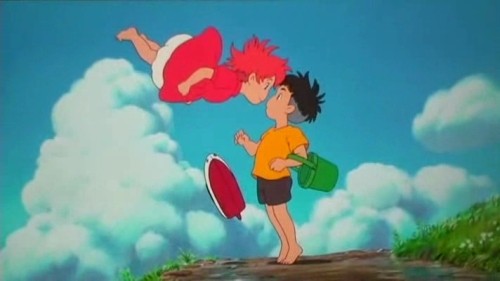
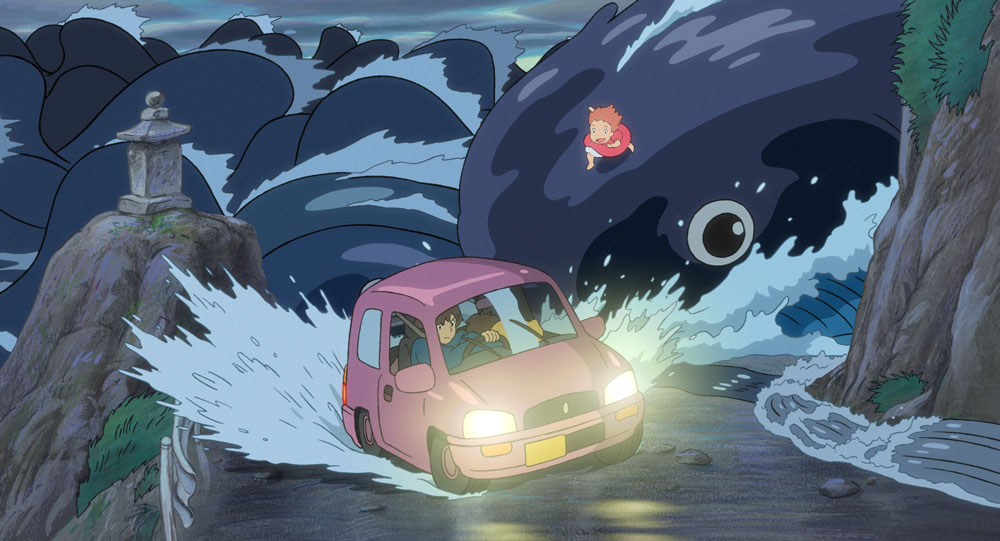
I was really delighted by Ponyo, Hayao Miyazaki’s latest fantastical children’s tale that springs from the most basic details of Hans Christian Andersen’s story “The Little Mermaid”.
Because I am a huge Miyazaki fan, it came as no surprise that I was entirely charmed by this movie. However, watching Ponyo helped me articulate to myself just what, exactly, I find enjoyable about Miyazaki’s films.
The aspects I enjoyed the most, in the case of Ponyo specifically, were the expressiveness of the animation and the near perfect conveyance of the wonderfully illogical imagination of children via the fantastical storyline and some of the film’s imagery.
In Ponyo the ocean is alive. It is filled with towering waves the size of monsters, fish-cronies that melt into the water, baby-faced mermaids that bulge into huge carp, goldfish that shape-shift into small magical girls, inexplicably giant women who save ships from disaster, and a myriad of other weird creatures and moments that just are. And the best part—I didn’t need an explanation for any of it. Something about Miyazaki’s style both enables and emboldens me to simply appreciate the incredible creativity that goes into the film and accept it for what it is.
When I watch Miyazaki movies I feel happy, boundless, and hopeful. I feel like I can tackle life’s greatest problems and challenges without any of the grown-up baggage that so often drags me down in real life (i.e. fears, anxieties, memories of failure, etc). I think this is because in Miyazaki’s worlds strange, awful, scary things are happening all the time all around, but the children that have to get through it do so without batting an eye.
If only we could all live somewhere in Miyazaki’s dream worlds!
09 April 2010
Diary of a Wimpy Kid (2010)
The primary take-away message of this movie is that kids between the ages of 12 and 16 are terrible people. Horrible excuses for human beings. Unethical jerks. Soulless, spineless, filthy monsters. Etc.
I am sure most readers have their own list of adjectives to add to these few choice phrases. In fact, I am willing to bet that anyone who went to a public middle school in the United States already knows full well the horrors of pubescent and adolescent folly, specifically relating to hubris, hygiene, and home life, which Diary of a Wimpy Kid highlights.
Yet though the appeal of the movie stems from the universal cringe-fest induced by the possibility of reliving one’s terribly awkward pubescent days, Wimpy Kid is nevertheless curiously devoid of any characters that the audience is invited to connect with. It was more the situations that struck a nerve, not the individual kids themselves. Which is not to say that the actors delivered a poor performance—far from it. I think the young actors in Wimpy Kid did a terrific and impressive job in their somewhat hyperbolized roles.
It was just that at the end of the day I couldn’t really sympathize with any of them, but rather was simply left with the uncomfortable feeling that I’d just been a reluctant witness to the humiliating and extremely debasing spectacle that is “coming of age”.
Of course I laughed quite a bit—some of the situations are very funny. But overall, it felt like a downer. But maybe that was the whole point?
01 April 2010
How to Train Your Dragon (2010)
Ok so… I hate Jay Baruchel’s voice, which was kind of a problem here, being as he voices the main character.
Also a problem: generally unappealing character design. Some of these dragons looked like flying poops. I’m not kidding.
Story was decently entertaining, some funny moments. No surprises in terms of plot or message.
Fun and impressive use of 3-D. Very very cute characterization of one dragon (Toothless), who resembled a cross between a black cat and a pokemon.
Overall: meh. Not entirely a waste of time, but ultimately, forgettable.
Subscribe to:
Posts (Atom)


 Posts